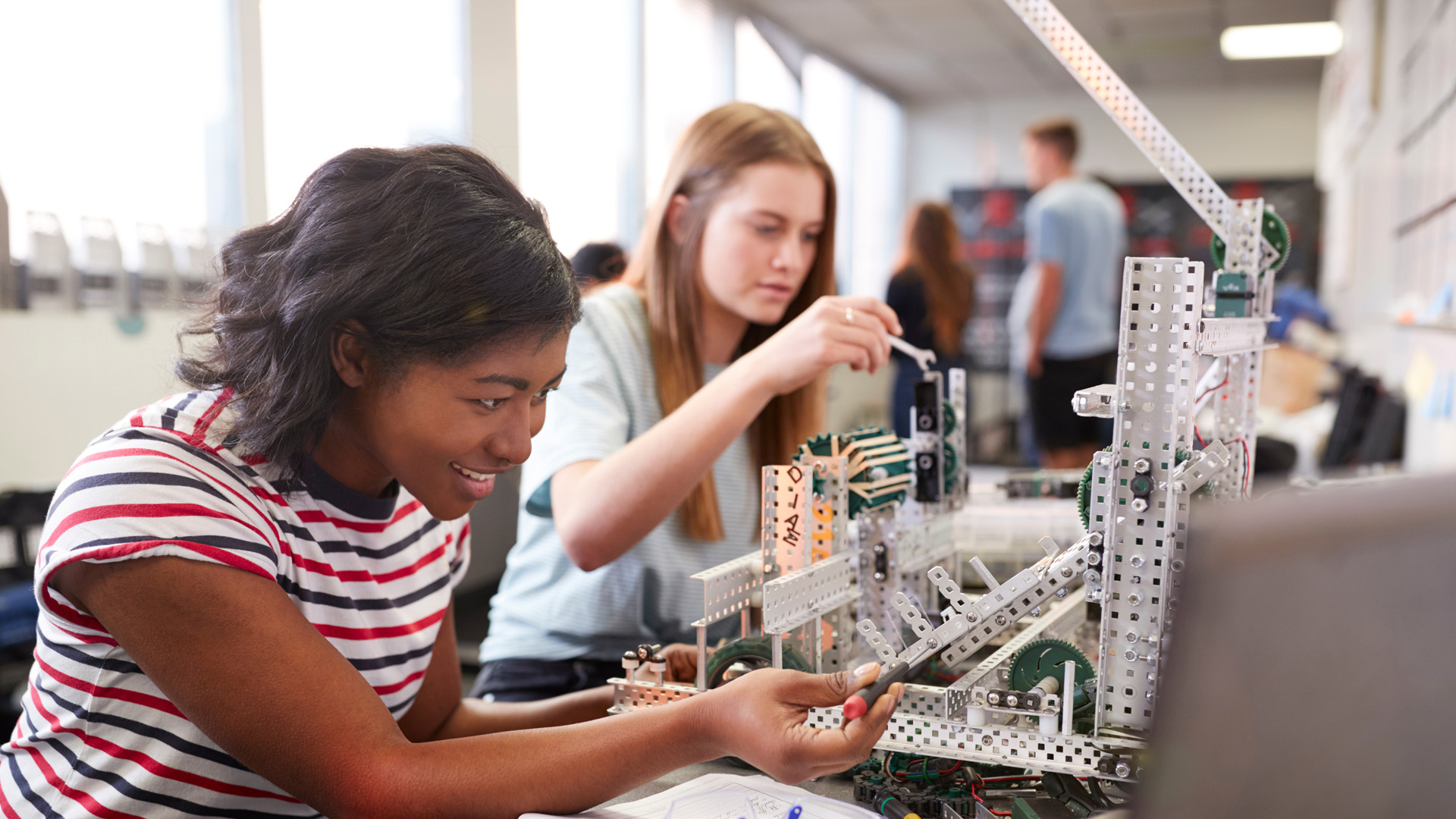
Join a growing community of students participating in STEM research, internships, clubs, IDEA Lab and more to better prepare for transferring into a university STEM degree. RRCC provides students with strong academic programs in STEM, as well as many opportunities to get hands-on experience both in and out of the classroom. Whether through a biology research experience, Engineering Academy, or real world project in the IDEA Lab, RRCC encourages students to get involved in several STEM experiences to strengthen academic and career goals, discover best transfer pathways, and find support for STEM learning. Students who become involved in STEM activities become likely candidates for STEM Scholarships. Take advantage of all that RRCC has to offer!
STEM at RRCC includes
- Associate of Science degree with areas of study in Engineering, Biology, Chemistry, Geology, Physics, and Mathematics
- Additional science courses can be found through our Science Program

The IDEA Lab is the center of innovation and STEM at Red Rocks. Tools, resources and design space available to support prototyping and building STEM projects. 3-D printers, microcontrollers, soldering, whiteboards and more! Located on west end, across from Student Life Desk.

The Engineering Transfer Program supports students to transfer into a four-year engineering or computer science degree.
Partnerships with universities, industry, and community provide RRCC engineers with opportunities to gain real world experience while preparing for transfer and future engineering careers.
Fast facts
- #1 in transfers to Colorado School of Mines
- NEW! Mines Academy at Red Rocks Community College to launch in Fall 2022
- Transfer 60 credits through agreements with multiple university partners
- Engineering and STEM Scholarships
- Opportunities for internships and research
- IDEA Lab makerspace

Looking for research or work experience? Consider an REU (Research Experiences for Undergraduates), an internship, or other work-based experience. Below are some suggestions to get you started.
This REU is designed as an 11-week program where students will tackle an interdisciplinary problem in materials informatics. Participants will receive a stipend of $6,600 for the summer and will be provided with on-campus housing. Assistance with travel expenses is also offered.
- Application Submission: Jan. 15th – Mar. 1st
- Application Review Begins: Feb. 15th
- REU Dates: May 18th – July 31st
Students who have been accepted to Mines can spend the transitional summer months between community college and Mines performing authentic, cutting-edge research through Bridge Opportunities for Transfer Student Success. As a cross-cutting program, BOTS includes science and engineering researchers from across the Mines campus. A small fraction of these topics include water resources, energy, nanotechnology, biophysics, and robotics. Students without prior research experience are especially encouraged to apply.
Learn more about Bridge Opportunities for Transfer Student Success
DOE Community College internships are available through the DOE at one of their 15 laboratories, including the National Renewable Energy Laboratory (NREL) in Golden, CO. Students who are interested in entering technical careers relevant to the DOE mission should apply for a 10 week Summer internship or a 16 week Fall/Spring internship.
Geo-Launchpad helps students develop research-ready skills, and provides support in creating a career path in science, engineering, or technology. Interns spend eight weeks at UNAVCO in Boulder, Colorado, working on a collaborative project under the guidance of an UNAVCO project manager, culminating in a poster presentation. A Faculty Mentor from their home institution provides guidance and support before, during, and after the program.
RECCS is a summer research internship program for Colorado community college students. The goal of RECCS is to give community college students an authentic research experience that allows them to explore environmental or geosciences and gain the confidence to transition to a four-year program in the STEM (Science, Technology, Engineering and, Math) fields.
A 10-week program to work on a research project with a mentor. The topic areas span the field of solar and space physics, from instrument hardware to data analysis to modeling of the Sun, the Sun-Earth system, the near-Earth environment, or the heliosphere. Students will come to Boulder, Colorado for 10 weeks to work on a research project with a mentor. The topic areas span the field of solar and space physics, from instrument hardware to data analysis to modeling of the Sun, the Sun-Earth system, the near-Earth environment, or the heliosphere
This EOL Technical Internship program provides a unique experience to prepare science-focused students at two-year colleges for their future careers. Interns are hired for a paid internship to work hands on with technical and scientific support mentors. The internship lasts 20 hours per week for 12 weeks.
NCAS is an online community college internship program available to community college students. Chosen applicants will participate in a 5-week online course where they will put together various projects. The top students from the online course will get a chance to participate in a 4-day camp at a NASA location.
Welcome to a new year of space at RRCC
Check out our latest mission success! Be sure to pan around the 360 video
Interested in joining the 2022-2023 Space Grant Team?
Send an email to Lynne.Albert@rrcc.edu
RRCC is part of the NASA Space Grant Program
Red Rocks Community College recently became a part of the Colorado Space Grant Consortium (COSGC), a state-wide program that provides Colorado students access to space through innovative courses, real-world hands-on satellite programs, and interactive outreach programs. We are funded by NASA as part of National Space Grant Program. COSGC provides opportunities for undergraduate research projects that involve a high altitude balloon launch through the DemoSat program (a low-cost access to the edge of space to encourage student innovation, creativity and persistence in science and engineering).
This year's projects:
- GLEE lunar project Fall 2022
- RockSat X launch August 2023
- Telescope data network and radio telescope automation project
- Mars Grow projects - ongoing
- DemoSat launch April 2023
- Robotics Challenge April 2022
- RockSat rocket launch August 2022
The team designed, constructed, tested and deployed a 360 camera from space on a sounding rocket. A 360 VR experience is being developed now!
RRCC was part of the RockSat-X CCofCO team this past year. Project O.S.C.A.R. tested methods for space debris capture/ Their design and build was launched into space in August 2018. The Experiment deployed a mechanical arm, launched debris and captured debris. The secondary experiment tested small electrostatic charge methods.
RRCC students Christian Prather, Rhiannon Larsden (not pictured), Brianne Treffner and Maggie Franchois were part of this inter-collegiate team (RRCC, CCA and ACC). This year-long project is highly demanding and an amazing opportunity to work with NASA and be a part of a rocket launch program.
RRCC Space Grant students also built and tested a radio telescope!
RRCC students presented their projects at the Statewide Undergraduate Research Symposium at CU Boulder.
DemoSat team designed an experiment to cold-adapt yeast prior to exposure to high altitudes to see if their survival rates would be any different from control strains of yeast.
Robotics team brought their robotic rovers to the Colorado Robotics Challenge at Great Sand Dunes National Park
Students presented their projects at the COSGC Annual Research Symposium.
RRCC student, Christan Prather was the Grand Prize winner for his talk and paper on designing a low-cost thermocycler for DNA research.
RRCC participated in several Eclipse projects. We were selected to be one of four schools to design and build a system to live stream the eclipse from space as part of the High Altitude Eclipse Project. We also had a RRCC team design an experiment to be launched during the eclipse to expose seeds to Martian-like conditions and then grow the seeds in simulate Martian soil after exposure. We also flew a bacteria panel for NASA Ames Research Astrobiology program. We all experienced the total eclipse and did science in Guernsey, WY. It was amazing for all involved.
Last year was very exciting. We had a DemoSat launch, a robotics team and a RockSat team.
Our Demosat team designed a two pronged experiment. They tested the viability of different 3D printed materials as well as tested the microbial viability of samples sent up to high altitude.
Our robotics team designed a very unique robot that competed at the Colorado State Robotics Challenge in April 2016. As you can see from the photo, there were some unexpected blizzard conditions, but our robot did great! The team even won the "perseverance" award for the Challenge. Great job team!
RRCC student winners at the COSGC Symposium: Best Poster demo by Shelby Ryan and Melissa Breathwaite
Our students also participated in an Inter-collegiate team to design and built a rocket payload. Our team launched their payload into space from Wallops Space Flight Facility in Virginia. It was an amazing opportunity for all involved. The payload tested a muon detector, carbon fiber radiation shielding, and DNA viability during spaceflight.
In 2014-2015 RRCC formed the first DemoSat team who designed an astrobiology themed project for their edge of space research. The team designed a unique DemoSat flight package, obtained permission from the National Park service for collection of the microbial mats from Bad Water, CA, and devised a unique approach for studying the microbial community response to edge of space conditions focusing on viability studies and DNA probe analysis. Students launched their payload in April 2015, complete with four biological samples mounted for exposure. The balloon flight was two hours and reached a maximum altitude over 90,000 ft. Students prese
Presented their research results at local and national conferences.
Experience science through a unique combination of coursework and travel!
Earn academic experience while experiencing science in the field. RRCC has hosted a variety of faculty-led science field studies.
Current Field Studies:
See current student academic travel opportunities here.
Past Science Field Studies:
- 2022 - Tanzania (BIO 228 Field Biology)
- 2022 - Belize Honors Experience (honors trip with Mines Honors )
- 2019 - Belize Honors Experience (joint science and society and spanish)
- 2018 - Costa Rica (joint Environmental Science & Spanish)
- 2017 - Wyoming - Total Solar Eclipse
- 2017 - Hawaii (joint biology and geology)
- 2017 - New Mexico - (joint astronomy and archeology)
- 2016 - Tanzania (BIO 228 Field Biology)
- 2015 – Hawaii (joint biology and geology)
- 2014 – Tanzania (joint biology and anthropology)
- 2014 - Southern New Mexico (joint astronomy and archeology)
- 2013 – Hawaii (joint biology and geology)
- 2012 – Peru (biology)
- 2014 - Northern New Mexico (joint astronomy, geology, and archeology)
- 2011 – Hawaii (joint biology and geology)
- 2010 – Costa Rica (joint biology and geology)
- 2009 – Hawaii (joint biology and geology)